

In honor of World Hunger Day 2026…
See also: Plants for Hunger Relief and PHRESH
The Food Security Advantages of Plant-Based Foods
The UN has urged that by 2050, the world will need to produce 50% more food(opens in new tab) without using any more land, while at the same time reducing agriculture’s greenhouse gas emissions by two-thirds. Animal agriculture currently uses a whopping 83%(opens in new tab) of all agricultural land, and is one of the leading human-caused sources of climate change, contributing as much as 37%(opens in new tab) of global greenhouse gases. Even by conservative estimates, emissions from animal-sourced food production are more than emissions from all forms of global transport—aviation, automobile, train, and shipping—combined.
Despite this disproportionate impact, meat, dairy and egg production provide a mere 18%(opens in new tab) of global calories. UN experts have also estimated that we could feed an additional 3.5 billion(opens in new tab) more people simply by growing crops for human consumption on land currently used to grow feed for livestock. In fact, a global shift to plant-based food production could reduce global farmland use by up to 75%(opens in new tab), drastically decreasing deforestation and habitat loss, and cutting greenhouse gas emissions from the food system by half(opens in new tab).
This is critical. While emissions from the energy sector have long received the bulk of attention, emissions from the food system are a major contributor to climate change that scientists say we can no longer ignore. A study published in Science(opens in new tab) warned that even if global fossil fuel use were halted immediately and all other emissions were eliminated, greenhouse gas emissions from food production alone would make it impossible to limit warming to 1.5°C, overshooting the carbon budget by the middle of this century. Even keeping warming below 2°C would be difficult if not impossible without major dietary shifts, those scientists urged.
While half a degree, or even a difference of two degrees, may sound small, scientists say each increment of warming spells fundamental– and irreversible– disaster for life on our planet, from increasingly lethal and widespread heat waves, unprecedented global crop failure and resulting famine from more intense drought and flooding, ecosystem collapse from the Amazon rainforest to the Arctic, and entire cities and coastal regions disappearing under rising seas.
Food Aid Shapes Future Consumption Patterns
If we combine the different categories of food-related assistance programs worldwide—including school feeding programs, famine relief rations, food stamps and other government welfare vouchers, free meal programs, community food banks, subsidized staple foods, and direct food distribution from humanitarian organizations and charities— an estimated 10-20%(opens in new tab) of the global population receive some form of food aid at any given time.
Global school meal programs alone help feed some 466 million(opens in new tab) children in need annually; that’s nearly 6% of the world population. And in the U.S., more than 12% of people (roughly 42 million) participate in the Supplemental Nutrition Assistance Program (SNAP).
Given the global scale of these numbers, it’s important to consider that food aid doesn’t just address a present need for nourishment; it also shapes future consumption patterns.
To give one example, the many hunger charities like Heifer International, Oxfam, and others that “gift” live animals as food(opens in new tab) to families experiencing poverty may appear to just focus on small-scale animal farming, but they have extremely large-scale implications that pave the way for industrial or “factory” farming and exponentially increase consumption of meat, dairy, and eggs throughout entire countries.
Heifer International(opens in new tab), for instance, is largely considered responsible for the kick-off of industrialized dairy in Japan after World War II. Heifer also boasts that their projects produced 3.6 million gallons of milk in one year in Uganda, and developed a national dairy program in Tanzania.
These massive programs were launched despite the high prevalence of lactose intolerance in these regions (more than 90% of the population in some Asian and African countries), and despite the fact that native plant crops(opens in new tab) are capable of producing equal or greater amounts of protein, calcium and other nutrients.
Heifer International has also partnered with Cargill, the largest privately held corporation in the United States and the largest factory-farmed meat conglomerate in the U.S., to expand chicken farming in lower-income communities across the globe. Their partnership, called Hatching Hope, is currently working to increase poultry production in Kenya, India, and Mexico, with plans to expand to other regions. To create local demand for increased chicken production, they announced that “Cargill and Heifer will run local and national education campaigns on the health benefits of eggs and poultry.”
In July of 2021, Animal Save India (ASI) visited the eastern state of Odisha to investigate the impacts of Hatching Hope. The project aims to create 60 million backyard chicken operations in India alone by 2030. According to ASI, “Many in the tribal communities are unhappy with the consequences of Hatching Hope, particularly due to recent bird flu outbreaks in the region, extra mouths to feed and youth denied the chance to go to college because they have to farm chickens.”
Outsourcing Environmental Strain and Inequity
Critics point out that Big Meat corporations like Cargill only get involved in charitable development projects in order to grow the market for their own products. Cargill benefits from the Hatching Hope partnership by supplying the hatchlings and feed, along with technical assistance to help families build larger chicken operations.
But where does that feed come from? Cargill(opens in new tab) sources a major portion of its farmed animal feed, particularly soy and corn, from South America. After coming under fire when investigations revealed much of their monoculture feed crops were driving deforestation in the imperiled Amazon rainforest, Cargill agreed to stop procuring soy from newly deforested regions there. But they then switched to sourcing more of their soy— which is turned into chicken feed— from the Brazilian Cerrado, another rainforest being decimated by deforestation. They also resisted calls for a soya moratorium for the Cerrado and encouraged competitors to do the same.
Even more influentially, under the guise of increasing food security, Western development banks, private investors, and multinational agribusiness corporations have played a major role in accelerating meat and dairy production and consumption in Asia and the Global South. This transformation is now referred to as the “Livestock Revolution.”
Critics and analysts maintain that people in lower-income countries did not just “naturally” begin consuming more meat and dairy as incomes rose. Rather, global lenders, corporate investors, and development institutions with pro-meat biases and vested interests actively helped build the infrastructure, supply chains, and consumer markets that made large-scale increases in meat and dairy consumption possible.
These forces not only increase the consumption of animal-sourced foods; they also increase emissions and environmental strain, often in regions already experiencing land degradation and scarcity, water stress and scarcity, and increased weather disasters such as drought and flooding due to climate change.
A World Bank report recently revealed that some 92% of people globally live with degraded land, polluted air, or water stress. 80% of people in low-income countries live with all 3 of these stressors, compared to 43% of people in higher income countries exposed to none. And the leading driver of all three of these stressors, as environmental scientist Nicholas Carter(opens in new tab) points out, is animal agriculture.
Competition for farmland has also led to the growing phenomenon of “meat grabs,” a form of land grabbing where large-scale land acquisition deals are made by foreign investors, corporations and governments to facilitate industrial meat, dairy and egg production, with little regard for the rights and needs of the people inhabiting the land. The majority of foreign land grabbing occurs in Africa, Asia, and Latin America, where it poses significant threats to food security, environmental sustainability, and social equity, and often leads to the displacement of indigenous and local communities. Experts say that land grabs in these regions have shifted production away from local staple foods and led to reduced dietary diversity.
Plant-Based Food Aid: Modeling Solidarity, Seeding a Sustainable Future
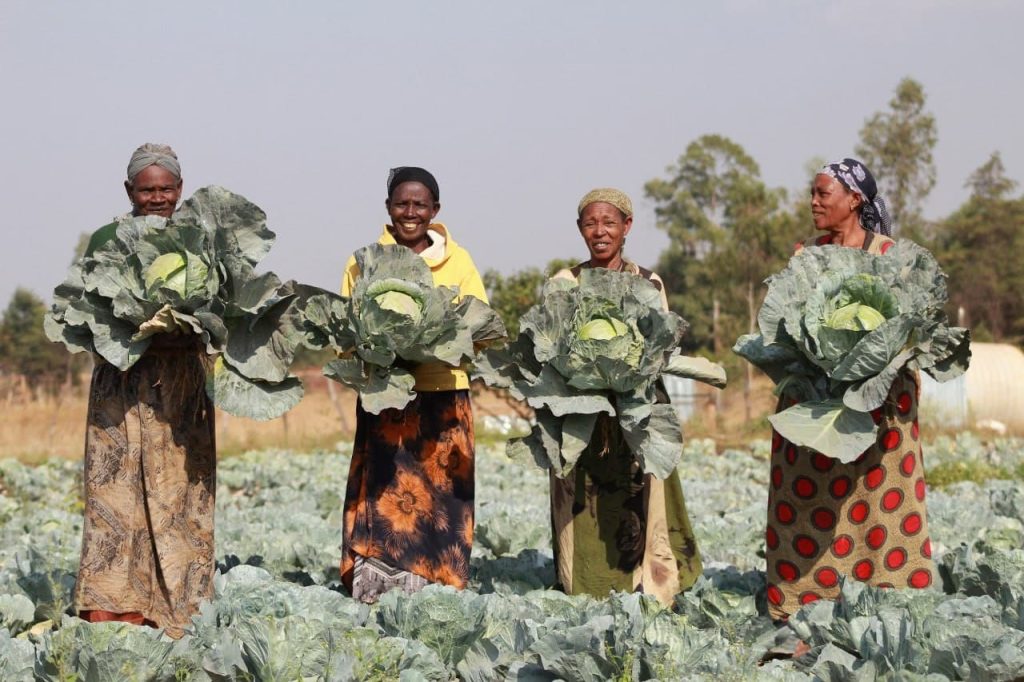
With reducing emissions from the food system forming a crucial part of any viable climate mitigation strategy, and with food aid playing a pivotal role in shaping future consumption patterns, a shift to more plant-based hunger relief is paramount. Yet very few hunger charities have adapted their aid model accordingly. Charities like Heifer International, Oxfam, World Vision, and many others continue to promote “send a cow”(opens in new tab) and “give a goat”-style campaigns, even in drought-stricken regions where climate change is making animal farming increasingly unviable (and causing untold suffering to the animals themselves).
By contrast, A Well-Fed World’s Plants-4-Hunger program was created as a compassionate, climate-friendly alternative to “animal gifting” campaigns. Plants-4-Hunger(opens in new tab) funds plant-based feeding, farming, and disaster relief(opens in new tab) projects around the world that feed more people with far less land, water, energy, and emissions.
Importantly, we work with local partners in each region to implement plant-based feeding and farming initiatives that are culturally relevant and appropriate, frequently strengthening already existing plant-based projects spearheaded by community members. Plants-4-Hunger(opens in new tab) sponsors plant-based free school meal programs in low-income countries and communities; food tree and food forest plantings; school and community vegetable gardens; bean seed distribution; plant-based food pantries, community fridges and meal shares; disaster relief food aid; and soy processing equipment to empower women’s microbusinesses in rural villages.
Successful plant-based feeding projects in these regions also model the efficacy and acceptability of plant-based eating to stakeholders, investors, development orgs, and policy makers like the UN, who increasingly underscore the need for a shift to more plant-based diets in their climate assessments, yet too often refrain from policy recommendations that would help curb the expansion of meat and dairy production and consumption in lower and middle income regions.
Cross-Movement Solidarity
Plant-based food aid not only helps create the conditions needed for a greater global shift to more plant-based diets; it also demonstrates solidarity with other humans and causes for justice.
Food is a universally and politically meaningful form of care, and can serve as a bridge between justice movements. Building on the work of Plants-4-Hunger, our PHRESH and Feeding Equity(opens in new tab) initiatives were launched for exactly this reason.
PHRESH is our Plant-based Hunger Relief and EcoSolutions Hub that provides a directory of plant-based hunger relief organizations and programs, most of whom we have supported through direct grants, fiscal sponsorships, or extensive partnerships. It’s a way to boost the visibility and reach of other organizations doing mission-aligned work.
Feeding Equity provides grants to vegan-led and vegan-friendly groups working for social equity. The initiative prioritizes efforts such as providing nourishing plant-based meals at racial justice actions, Pride events, democracy and human rights rallies, mutual aid distributions, and other movement spaces where food access is essential to collective care and resilience.
Despite growing recognition that systems of oppression are interconnected, animal advocacy and human justice movements often remain siloed. As a result, critical opportunities for solidarity-based, movement-building work remain underappreciated, despite their potential to strengthen public trust, forge alliances, and grow awareness of the relevance of animal protection to human justice causes.
The misconception that “vegans only care about animals” undermines the coalition-building capacity of the movement. Our Plants-4-Hunger, PHRESH, Feeding Equity, and other initiatives directly challenge this narrative by showing plant-based organizations and individuals actively working for human rights and justice alongside their work advocating for animals.
This matters for animals. Movements perceived as indifferent to human suffering struggle to build mass support. By contrast, when animal advocates show up materially for other movements, they build trust and credibility, reduce resistance, and create conditions for deeper engagement with the animal rights cause, and for building understanding of the interconnectedness of human and animal liberation.
Seen in this light, it is clear that plant-based hunger relief comprises an important and strategic form of plant-based advocacy that advances the understanding that systems that exploit animals are also inseparable from systems that oppress and marginalize human communities. Additionally, people are more receptive to conversations about animal justice when they experience the vegan/plant-based movement(s) as generous and inclusive.
Lasting change requires coalition, not isolation. As Author Natalie Braine has noted(opens in new tab), “Solidarity across movements is not just morally right – it’s strategically necessary. We cannot change the narrative about animal freedom as a legitimate freedom struggle by remaining isolated. But we can help change it by showing up in diverse social justice spaces…and by deepening connections with other movements.”
If this resonates for you, please consider a one-time or recurring gift to our Plants for Hunger Relief(opens in new tab) program. Our hunger relief grants and advocacy are funded through the generosity of supporters like you.
Published May 29, 2026