

Carnism (a term coined by Dr. Melanie Joy, founder of Beyond Carnism) is the invisible belief system that conditions people to eat certain animals. It explains why societies often view eating cows, pigs, and chickens as normal, while eating dogs and other animals feels unthinkable.
Why People Eat Certain Animals and Not Others
 For most of us, eating animals has always been presented as normal, natural, and necessary. In this worldview, eating animals is not a question of ethics, but a simple fact of nature; it's just what we do.
Consumers of meat, dairy, and eggs are thus seen as participating in an age-old and universally accepted practice, while vegetarians and vegans are perceived as uniquely bringing a set of beliefs to the dinner table. But is this accurate?
As Dr. Melanie Joy, social psychologist, writes: "When eating animals is not a necessity for survival, as is the case in much of the world today, it is a choice—and choices always stem from beliefs. Most of us do not, for instance, eat pigs but not dogs because we don’t have a belief system when it comes to eating animals."
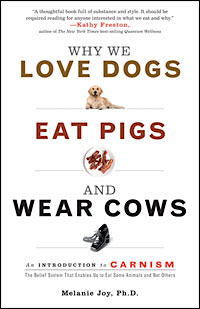
So why do we love dogs, eat pigs and wear cows?
This question forms the basis of Dr. Joy's ground-breaking research (as well as the title of her best-selling book.) The reasons, she concludes, stem from an oppressive, entrenched ideology that conditions us to disconnect from our most deeply-held values—values such as empathy, compassion, and justice—in order to make food choices that cause immense, unnecessary violence and suffering.
She calls this ideology carnism—the invisible or unrecognized belief system that conditions people to love certain animals while eating others, despite the fact that animals used for food have personalities, emotions, and preferences as rich and unique as those of our beloved cats and dogs.
Melanie Joy's TEDx Talk
Dr. Joy explains this contradiction, and its devastating consequences for both people and animals, in her powerful TEDx talk below, which went viral in only the first few weeks of airing:
More details at Beyond Carnism and if you were moved by Melanie Joy's TEDx talk, please share it on social media with the text, "Psychologist explains why people eat certain animals but not others."
Core Concepts of Carnism
- It's the dominant yet invisible ideology: Most people don't realize they're participating in a belief system.
- It relies on denial: The system is sustained by keeping the realities of animal farming out of sight and mind.
- It uses justifications: Common rationalizations include “It’s natural,” “It’s normal,” and “It’s necessary.”
- It shapes perception: Carnism influences how people emotionally disconnect from the animals they eat—often by categorizing them as food, not beings.
Why Carnism Matters
Understanding carnism helps explain the psychological and cultural forces behind dietary norms and why plant-based advocacy often meets resistance. It’s not just about personal choice; it’s about challenging a deeply embedded system that affects animals, the environment, and human health.