

There is a common misconception that dairy is more benign than meat, but its harms to animals, the environment and human health are just as severe and in some cases even worse. Below is an overview, with more details at HumaneFacts and PlantMilksRCool.
Intro
Across the board—by every environmental metric—plant-based dairy alternatives are far better for the planet than even the most sustainably produced dairy products.
Cow’s milk generates at least 3x more greenhouse gas emissions than plant-based milks, utilizes roughly 10x more land, consumes up to 20x more freshwater, and leads to vastly higher levels of eutrophication—the pollution of lakes, rivers and oceans with excess nutrients that poison freshwater and marine ecosystems and create mass dead zones.
While dairy from grass-fed, free-range and other types of grazing systems is better in terms of animal welfare (though hint: it’s never a win for them), grazing requires vastly more land and generates about triple the heat-trapping methane, a greenhouse gas much more potent than CO2 (20x-25x more potent over 100 years and 80x-87x more potent over 20 years) .
Based on real world data, if everyone in the U.S. switched to oat or soy-based dairy products, they’d save the equivalent in greenhouse gas emissions of approximately 46,000,000 cars taken off the road annually; 153,000,000 football fields’ worth of land; and approximately 23,000,000 Olympic pools worth of water.
Deforestation & Land Use/Misuse
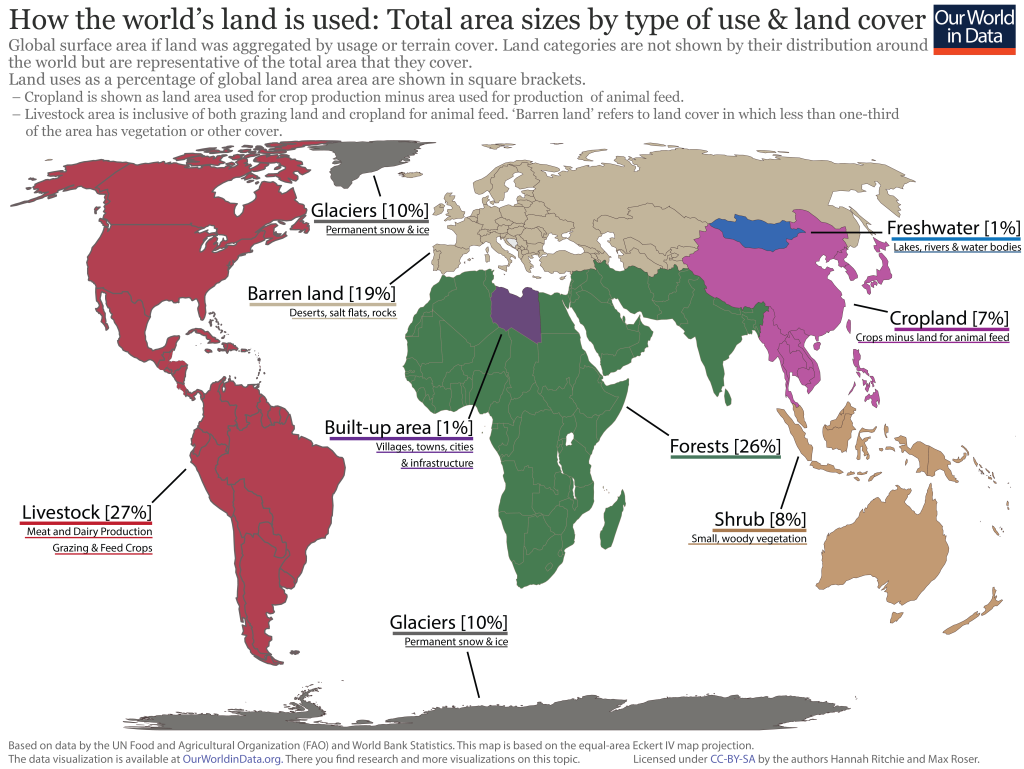
Grazing animals use a whopping 26% of the planet’s ice-free land. When combined with the 33% of arable land used to grow livestock feed, animal agriculture accounts for a staggering portion of global land use. This footprint drives deforestation, biodiversity loss, and soil erosion, particularly in critical areas like the Amazon rainforest.
More than 18 million acres of Earth’s forests are currently being lost every year — that’s the equivalent of 27 soccer fields of forest lost per minute.
10,000 years ago, half of earth’s land surface was covered in forests. But a full half of those forests have been lost due to human pressures, with much of the destruction occurring from agricultural intensification in the last century alone.
Indeed, clearing land for cattle pasture is now estimated to be the number one driver of deforestation worldwide. A full 42% of global pastureland used to be forests.
Cattle pasture currently occupies 45.1 million hectares (Mha) of deforested land between 2001 and 2015, accounting for 36 percent of all tree cover loss associated with agriculture in that span of time.* During that same period, the conversion of forests to pasture resulted in 5x more deforestation globally than for any of the other leading deforestation-driving commodities, with the bulk of forest replacement by cattle occurring in tropical forests.
The UN has urged that by 2050, the world will need to produce 50% more food without using any more land, while at the same time reducing agriculture’s greenhouse gas emissions by two-thirds. Meanwhile, animal agriculture currently uses a whopping 80% of all agricultural land, while providing a mere 18% of global calories.
According to scientists, a global shift to plant-based food production could reduce global farmland use by up to 75%, drastically decreasing deforestation and habitat loss, and cutting global greenhouse gas emissions by half. Additionally, UN experts have estimated that we could feed an additional 3.5 billion more people simply by growing crops for human consumption on land currently used to grow feed for livestock.
Global Warming & Air Pollution
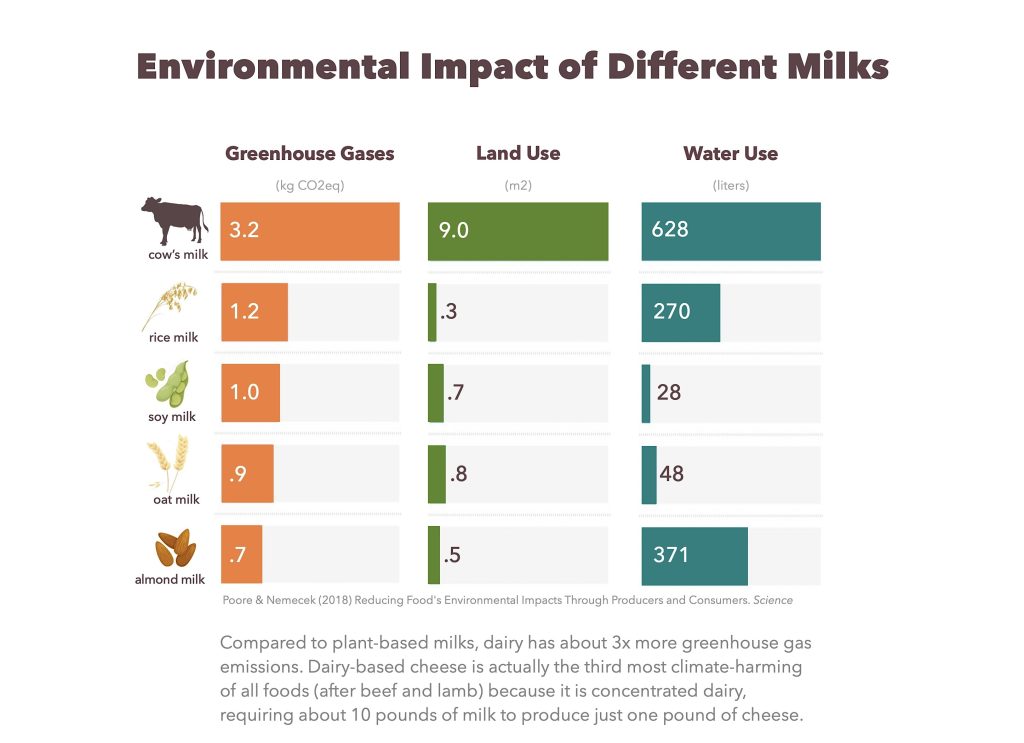
Cow’s milk emits 3x more greenhouse gas emissions than plant-based milks.
Animal agriculture is the largest human-caused source of methane, which is created in the ruminant digestive systems of animals like cattle, sheep, and goats. Methane is a far more potent greenhouse gas than CO2 because it traps significantly more heat (80x-87x more over a 20-year time frame). For this reason, products from grazing animals, such as beef, cheese, and lamb are ranked as the worst foods for climate.
In addition to greenhouse gases, dairy farming is a major source of dangerous air pollution, including nearly one quarter of the country’s total ammonia emissions. Air pollution from livestock operations has deadly results. Ammonia and particulate matter both cause and worsen respiratory illnesses like asthma and bronchitis, while long-term exposure can increase the risk of death from heart disease, cancer, and stroke.
In fact, deaths attributable to air pollution from livestock now outnumber deaths caused by coal-fired power plants. Every year, roughly 13,000 people in the United States are estimated to die as a result of their exposure to air pollution from animal farms, of which nearly 2,000 deaths annually are attributed to emissions from dairy farms.
Water Depletion & Pollution
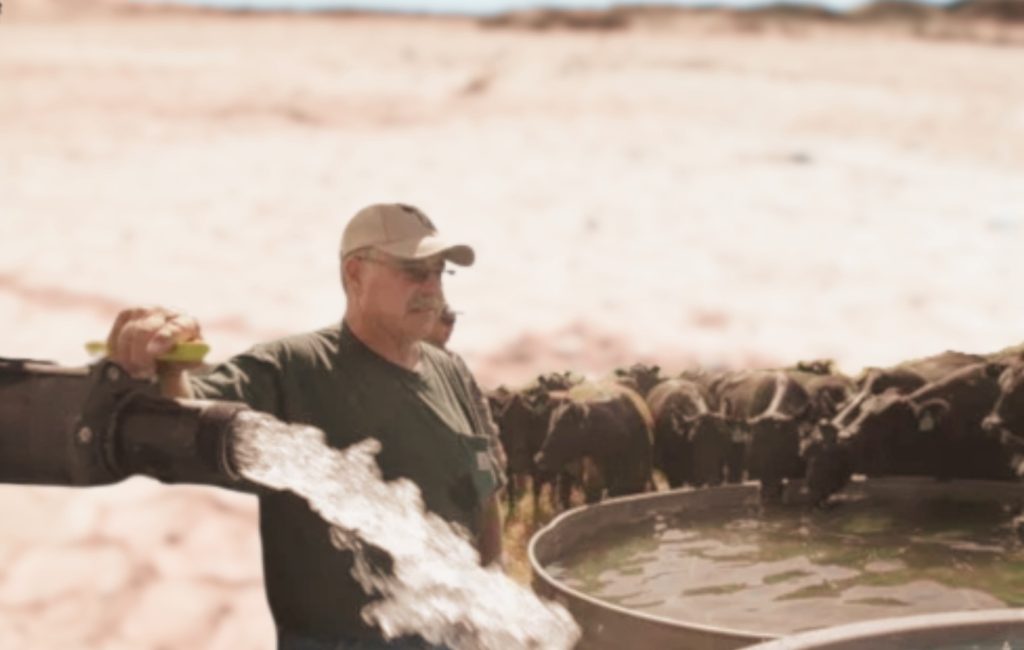
Due to human activity, the planet is experiencing unprecedented levels of water scarcity, with the UN now characterizing the situation as a “global water bankruptcy” rather than just a temporary crisis. The major driver of modern scarcity is over-consumption and misallocation, with human-caused climate change further exacerbating shortages.
Agriculture is the largest consumer of global freshwater, accounting for approximately 70% of all freshwater withdrawals. This includes both “blue water” (irrigation from rivers, lakes, and aquifers) and “green water” (rainwater stored in soil).
Of this, the livestock sector uses an estimated 30–40%, while producing a mere 16-18% of global calories through meat, dairy, and eggs.
More than half of all water used for farmed animal production goes to cattle for beef and dairy, the largest contribution to the sector’s water footprint.
While producing animal-based foods is disproportionately water intensive regardless of the production method, the majority of animal agriculture’s water footprint is currently attributed to growing feed crops.
In the US, the biggest feed crop for dairy cattle is alfalfa, an extremely thirsty crop. In drought-plagued California, which is both the biggest dairy producer and the biggest alfalfa producer in the country, animal feed crop production consumes 34% of all irrigated water, and alfalfa alone consumes more water than any other crop in the state. Indeed, 75% of all alfalfa grown in California is used for dairy cattle feed.
Dairy cattle also have the highest daily drinking water requirement per unit of body weight of any land animal. Between water for their hydration and irrigation for their feed crops and pasture, dairy farming uses more water than any other activity in California (much more than almonds). Cows raised for dairy can use 30-50 gallons of water per day, equivalent to 5 pounds of water for every pound of milk produced.
Dairy farms are also poisoning the world’s rivers. Manure from dairy farms seeps into aquifers and elevates nitrogen levels to the point of creating toxic “dead zones” that kill huge fish populations en masse, and contaminate drinking water for humans and wildlife alike.
Animal Harm: Dairy = Veal
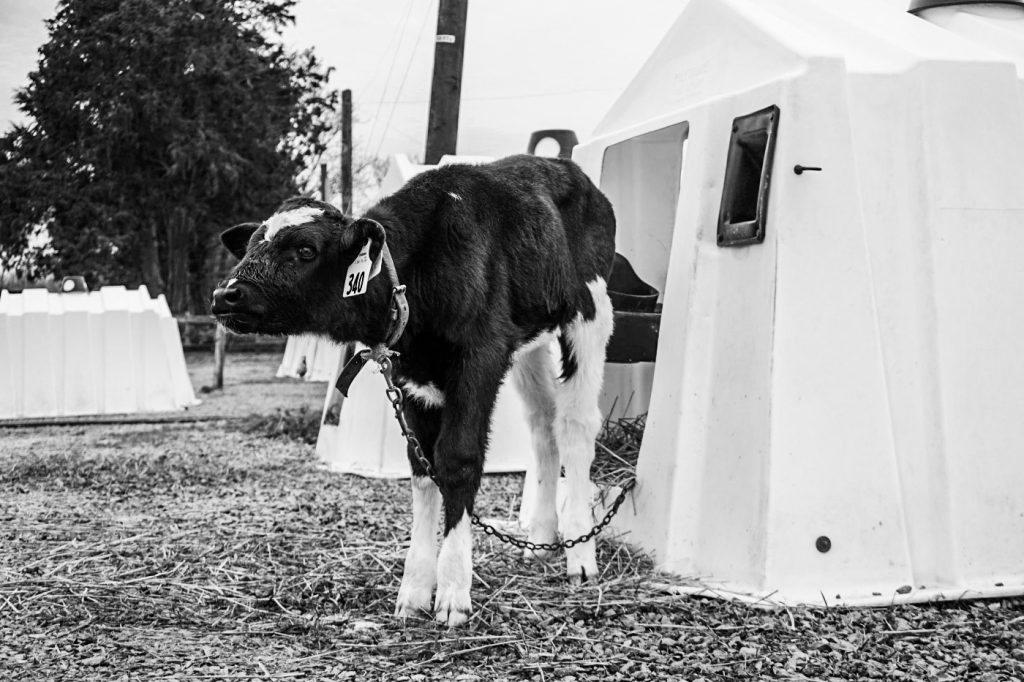
No matter the farming type (factory, family, organic, or those claiming to be “humane”), all forms of dairy farming cause tremendous suffering to animals.
Across species, milk is created for one reason: it’s baby food.
Like all mammals, all animals used for dairy must be impregnated and give birth to produce milk.
Just like human mothers, cows carry their babies for nine months, then begin to lactate in order to nourish their young.
For humans to consume the milk intended for calves, dairy production depends on repeatedly impregnating female animals, then taking newborns away from their mothers. This is the standard practice for cows, sheep, and goats… and it is devastating for mothers and babies alike.
If calves are female, they typically spend their first two to three months of life isolated in lonely hutches, fed on milk replacement formula so the milk intended for them can be sold to humans. Around one year of age, they will begin the cycle of impregnation and separation until their milk production declines, and then will be slaughtered for cheap beef.
If calves are male, they will be immediately slaughtered for veal or cheap beef.
An estimated 10-20 million dairy calves are slaughtered for veal or cheap beef every year globally. This is also true for cows used on dairy farms claiming “humane” labels.
Learn more at our educational companion sites, HumaneFacts and PlantMilksRCool. See also the Dairy Health Concerns page of the Physicians Committee for Responsible Medicine.
Image: dairy/veal calf in chained isolation at a “humane” labeled dairy farm in Asheville, NC – ashevilledairy.com
Last updated April 19, 2026