

This Beans Not Bugs page is a subset of forthcoming Beans Not Beings campaign. Read below for details about the many harms of insect farming for food security.
Intro
Insect farming is marketed as a sustainable alternative to traditional meat, but the evidence tells a different story. Scaling up insect production requires significant resources and causes serious environmental harm.
Rather than pouring time and money into inefficient, sub-par solutions, it's better to scale up plant-based proteins like beans, which are familiar, affordable, culturally flexible, climate-resilient, and genuinely sustainable. Beans are a win-win-win: they nourish people, protect animals, and help the planet thrive.
Eating Insects: Human Food & Animal Feed
As climate scientists have continued to warn of the need for swift and drastic reductions in meat and dairy production, calls to normalize and increase human consumption of insects have been heavily publicized, with insect farming promoted as a sustainable and efficient way to feed the planet.
However, despite the sector’s claims, evidence suggests the production of insect protein for human food and animal feed is neither economically nor environmentally sound. Additionally, concerns about the animal welfare implications of insect farming continue to grow as science increasingly demonstrates the likelihood that insects experience pain.
Research also finds insect farming unviable as a strategy to replace or reduce global meat consumption due to consumer unwillingness to eat insects in cultures where they are not traditionally consumed. Meanwhile, increasing the use of farmed insects as livestock feed, which is currently their primary use, could actually worsen the environmental impacts of meat production.
Rather than investing inordinate time and funds into attempts to persuade billions of people to consume a novel food they perceive as inedible, a better route to climate mitigation and global food security lies in the promotion of sustainable plant-based proteins such as legumes that are familiar, affordable, accessible, and culturally accepted across the globe.
Low Consumer Acceptability
According to the FAO, roughly 25% of the global population, or about two billion people, regularly consume insects as part of their diet, especially in tropical regions of Asia, Africa, Mexico, and Central and South America.
However, despite insects forming part of traditional diets in some populations, experts say that the promotion of insects as a meat substitute in cultures where they are not historically consumed is ill-advised, diverting funds and resources that could be better spent on growing the market for plant-based proteins that show much greater consumer receptivity. A 2025 scientific review published in Nature
found that insect-based foods "have a low likelihood of significantly reducing meat consumption, particularly when compared to more accepted plant-based alternatives."
Indeed, public polling in the US and Europe has revealed that while a significant majority (91%) expressed willingness to try plant-based meat alternatives, only around 20% indicated openness to trying meat alternatives that included insects. That percentage drops even lower when reflecting the number of consumers open to regularly incorporating insects into their diets.
The Nature analysis found that, among meat substitutes, insect-based proteins consistently ranked lowest in acceptance, while plant-based options received the highest acceptance rate. Dustin Crummett, co-author of the study, noted:
“We have limited resources and we need to devote them to the most promising alternatives. It turns out that farmed insects consistently score the lowest of any of the meat substitutes and the actual market for them is incredibly small, even in places that have a tradition of eating insects.”
It's worth noting that where insects traditionally form a regular part of human diets, they are overwhelmingly caught in the wild; only 2% are farmed, according to the FAO.
But groups promoting insect consumption as an alternative to meat frame insect farming as the next frontier in industrial agriculture. Beyond the acceptability barrier, however, insect farming presents a host of economic and environmental challenges.
Accordingly, despite the buzz around bugs as human food, new and existing insect farming ventures are primarily geared toward producing animal feed.
Affordability
Many of the affordability claims and forecasts for cost-competitiveness of insect-based food and feed have relied on the assumption that food waste would be used as feed for farmed insects. However, more than a decade since the FAO published its widely cited report on the potential of insects to make food and feed more affordable and sustainable, that scenario has not played out.
Instead of feeding insects with food waste, grains and grain-based coproducts or byproducts that are already used as livestock feed are widely used, meaning there is competition for feed between the insect farming and meat and dairy industries.
Another major factor in cost is the need for multiple conversion cycles and trophic levels. First feeding plants to insects, then insects to livestock and fish, and then feeding those animals to humans results in greater inputs and losses than simply skipping the insect stage.
Energy demands for heating, lighting and processing on insect farms are also disproportionately high, keeping the industry’s initial sustainability, scalability, and affordability goals out of reach.
Together, all of these factors mean commercially produced insect protein remains far more expensive than traditional animal- or plant-based proteins, and far costlier than conventional livestock feedstuffs.
As Human Food:
If we look at the cost per gram of protein for beans versus crickets, the most commonly farmed insect available for human consumption in the US, using available market data, beans are the clear cost champions.
Dried beans average 1-2 cents per gram of protein, while canned beans run just slightly more at 3-5 cents per gram. The price of cricket-based protein, meanwhile, is significantly more, currently averaging between 11–28 cents per gram of protein for cricket protein powder.
As Animal Feed:
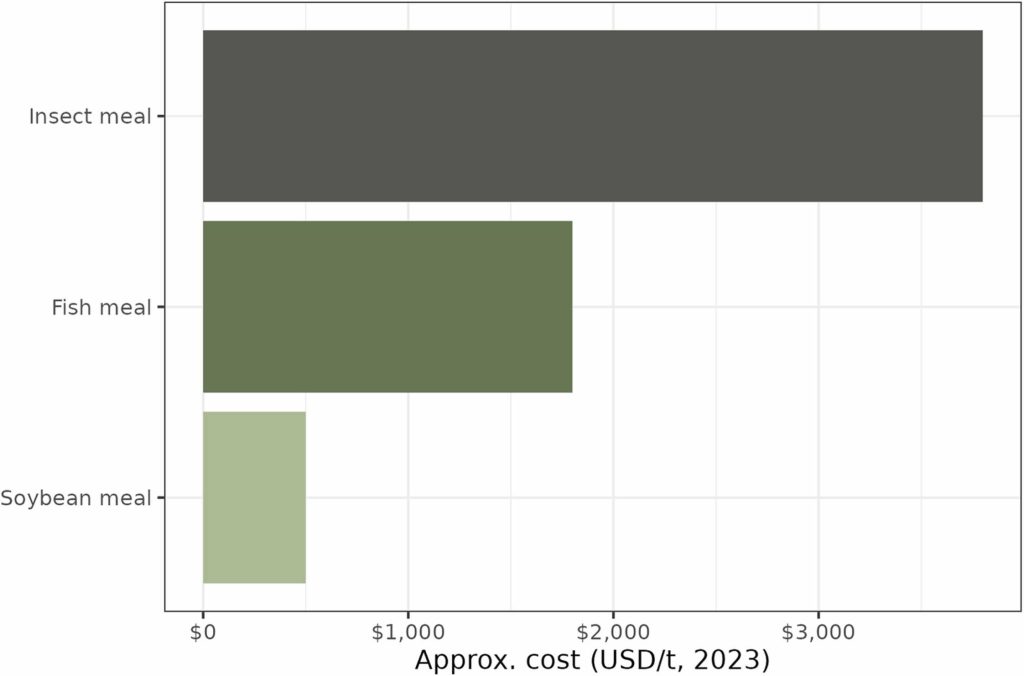
As of a scientific review published in December 2024, insect meal is far from basic price parity with common commercial livestock feeds, being 3-4 times more expensive than fishmeal and 10 times more costly than soybean meal.
Environmental Concerns
While historically insects have been used in feed for livestock in some developing countries, feed for commercially farmed land animals and fishes is overwhelmingly derived from corn, soy, fishmeal and fish oil, and other grains.
But the burgeoning insect farming industry is hoping to displace a substantial portion of the livestock feed sector, especially poultry and fish feed, with insect-based feed. This shift is primarily motivated by the potential cost savings compared to traditional feed ingredients. Companies have also asserted that using insects as feed for livestock and aquaculture could be better for the environment than using corn, soy, or fishmeal.
However, much of the industry’s initial claims around the sustainability of insect farming for livestock feed relied on the projected use of human food waste to feed insects, projections which have not been borne out.
Instead, most commercial insect farms use high-quality feed ingredients derived from crops that could either be used more efficiently to feed humans directly, or to feed farmed animals, which, while less efficient than using grains for human food, is still more efficient than adding another unneeded step in the production chain by feeding grains to insects to feed to livestock to then feed humans.
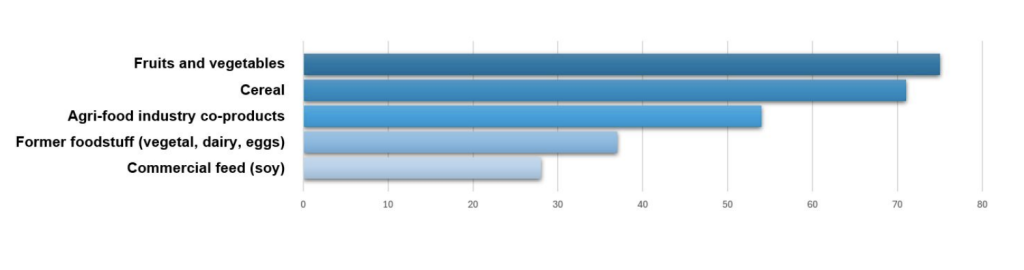
substrate). Per International Platform of Insects for Food and Feed.
A 2024 report on the European insect farming industry states that 75% of insect producers feed insects fruits, vegetables, and cereals (grains) that could be fed to humans, chickens, or pigs. Furthermore, roughly one-third of insect producers use commercial feed, including soy.
This means that, rather than reducing the environmental impacts of meat and dairy production by displacing the use of human-edible crops for livestock feed, insect farming participates in the same feed vs food competition it was supposed to alleviate.
When it does so, it also unavoidably contributes to the same environmental harms associated with the production of livestock feed crops, namely disproportionate water and land use, deforestation, habitat and biodiversity loss, and soil, water and air pollution from massive reliance on pesticides and synthetic fertilizers, along with the associated greenhouse gas emissions.
In fact, studies have overwhelmingly found that greenhouse gas emissions from insect farming are even higher than those generated by the production of traditional livestock feed.
In one recent study comparing the environmental impacts of farming Black Soldier Fly larvae (BSFL) to the impacts generated by soybean meal grown in Brazil and transported to the UK, the BSFL-based insect feed had a 5.7 to 13.5 times greater climate change impact than soy-based feed, and a 1.8 to 4.2 times greater impact than fishmeal feed. The range in impacts was dependent on the type of feed fed to insects as well as the amount and source of energy required. However, even when larvae were fed entirely on food waste, they had more than 5 times the emissions of soymeal and nearly twice the emissions of fishmeal, largely due to the amount of electricity that is required to rear and process insects.
Animal Welfare
Every year, trillions of insects (some estimates put this figure in the quadrillions) are farmed, exterminated as “pests”, reared for silk, shellac, and dye, and experimented on for research. An estimated 1-1.2 trillion insects alone are farmed for human food and animal feed.
Yet there are currently no welfare guidelines for the treatment of insects, and they are almost entirely excluded from animal welfare legislation, in part due to the misconception that insects do not feel pain.
Despite longstanding skepticism and resistance to the idea that insects and other invertebrates experience pain, a growing body of scientific evidence indicates the likelihood that they do.
Research suggests that insects are capable not only of nociception (detecting and responding to harmful stimuli), but also of the physiological and emotional components of pain, as well as chronic pain once an injury has been sustained.
While their nervous systems are different from those of mammals, a 2022 review found substantial evidence for pain in numerous species of insects, including those in the order Orthoptera, which includes locusts, grasshoppers, and crickets. Crickets are the most widely farmed species of insect on the planet.
The strong likelihood that insects experience pain carries serious moral implications. If we believe that it is wrong to cause unnecessary harm to animals, then this means we should avoid eating (and otherwise harming) insects for the same reasons we should avoid eating other animals; because they value their lives and want to live, because they hurt when we cause them harm, and because humans have no biological need to consume animals when we have plentiful access to nutritious plant-based foods.
If we're looking for a truly sustainable, affordable way to get our protein, the clear winner is beans, not bugs! Learn more about the amazing benefits of beans, and how to work them into breakfast, lunch, dinner, and even dessert, at our How You Bean campaign.